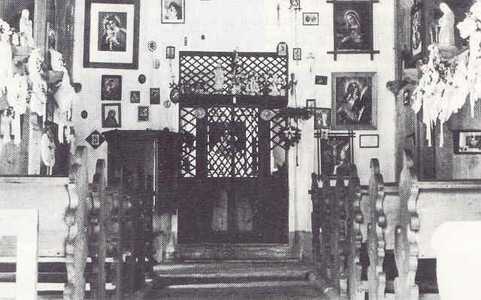
Inside the old Tusset Chapel
Up five mossy stone steps one reached the plain wooden door of the chapel, which was never locked. The visitors’ footsteps rang hollow on the wooden floor of the porch. Inside there was a greenish half-light, for the small windows were almost overgrown with woodland plants. To the left of the entrance stood a mighty granite „holy-water basin“. On the right a wooden stair led up to the small gallery, where the church choir had its place during services. The walls of the timber building were hung all over with votive pictures of the most varied kinds and sizes. Mostly they were simple prints with depictions of the Madonna, bearing on the edge the note „Maria hilf!“ (Mary, help!) or „Maria hat geholfen“ (Mary has helped). Some pictures bore this cry for help embroidered or sewn in glass beads. There were also several reverse-glass paintings among them, of the kind that hung in the devotional corner of our farmhouse parlours. By contrast there were hardly any votive tablets depicting events and help in some misfortune entrusted to the protection of the Mother of God.
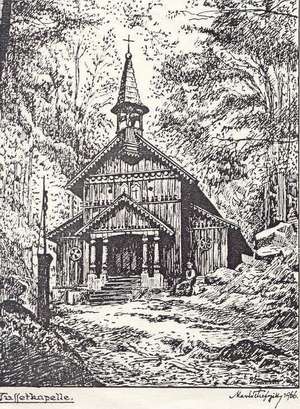
Such pictorial stories – mostly painted on sheet metal – were in our region reserved for the wayside shrines, which were usually set up beside the paths after accidents during forest work. On these too the Tusset Madonna was painted, mostly in a cloud, as the comforter of the victim, for example below the Hochbretter mountain or in front of the Guthausen halt – at the Zenzi – Engelbert shrine.
In the chapel itself there were only Marian pictures – with the exception of the reverse-glass paintings. All hung closely ranged on the timber walls of the porch. The pews were of spruce and, set up in two rows, left a broad central aisle which drew the eye towards the stone chapel. This was closed off by a plain wooden grille which allowed a good view through to the miraculous image. This grille door was of course opened during services. On the right there was also a kind of timber partition which served as a small sacristy. Here too the „Bark Madonna“ was kept for the forest altar on 15 August. To the left of the door was a small wooden pulpit – which, incidentally, was never used.
The central aisle of the porch was bounded by a row of wooden pillars which carried the roof structure of the higher, middle part of the roof. Where the curved rafters crossed the tie beams, various Marian statues also stood as votive offerings, among them several Lourdes Madonnas of the kind made at Steinbrener’s in Winterberg; but also glass ones, so-called silver Our Ladies.
Beneath them, hung on the long supporting beams, was something peculiar to the Tusset Chapel: small white cushions adorned with a little myrtle wreath and long white ribbons. I have not yet seen this kind of votive gift to Mary at any other place of pilgrimage. The explanation is quite simple: with us the death of a child was not exactly a rarity. In families with many children such a sad event occurred more often. Before the little coffin of a child, in the funeral procession to Böhm.-Röhren, there always walked a girl dressed in white, carrying in her hands such a small white cushion with the myrtle wreath. It was „given to the child“ in its grave. But there were cases in which a child died under particularly tragic circumstances. Often it was an accident, or „Halsbräune“ (diphtheria) suddenly carried off an older child. When the mother’s pain was almost unbearable, she brought the little white cushion with the myrtle crown to the Tusset Chapel. Our Lady of Sorrows, who had to drink the whole world’s suffering to the dregs, will surely also have eased the pain of many a mother’s heart there.
Only when the little myrtle wreath had shed its leaves and the white cushion had become shabby was it taken away – in the belief that the sorrow had now been eased.
That Mary helped not only in spiritual distress but also interceded in bodily „infirmity“ was borne witness to by a number of very roughly made crutches of wood and leather and „leg splints“ which hung and leaned beside the pulpit.
The timber annexe ended at the whitewashed wall of the stone building. Here too Marian pictures and rosaries hung around the wooden grille as votive gifts. On the right-hand side the grille had a small opening. Through it one could easily reach a mighty stone offertory box and put in a gift. The offertory box already stood inside the stone chapel.
But this presented the visitor with a quite different picture from the timber building. It was bright and flooded with light; there were large windows on both sides. The white walls and the pale blue ceiling made an uncommonly friendly impression. Not a single picture hung here either. The floor was tiled in yellow. The altar, plainly and simply designed, consisted really only of a simple table with two pale blue columned uprights and a sparingly painted garland of flowers in rustic manner. Thus the visitor’s gaze was drawn away by nothing and turned as if by magic to the great miraculous image of the Mother of God. Whether one stood before the wooden grille in the dark annexe or came closer to the altar through the open door, the impression of brightness and gentleness that came from the picture always remained. It is easy to imagine that the intimate mother-and-child relationship of the work had a comforting and reconciling effect on the heart of a troubled person. Many will surely have felt it so, and returned again and again to this solitary place of pilgrimage.
Around the Tussetberg
Böhmisch-Röhren
The parish village of Böhmisch-Röhren is a foundation from the flourishing time of the Golden Path. Here the packhorse traders watered their horses, and so the name of the place arose. It lies on a plateau, fenced in by the Sulzberg and the Schillerberg, open to the sun in the east. Despite its geographical height of 930 m above sea level it was soon free of snow, hardly knew the frosty nights of spring, and was therefore a popular upland air resort. The „summer visitors“ found a good welcome in the four inns and in numerous private lodgings. The place was the centre of the large parish district and therefore had several shops and craft businesses, especially woodworking businesses of every kind. There was also a doctor and a post office in the village. The bright, friendly village church rose above the village. It was built from 1788 to 1791 as St Anne’s Church. A spacious rectory closed off the church square. Below the church stood the large school building with four classes and the teacher’s flat. The cemetery lay not by the church but beside the road junction towards Schillerberg. The parish of Böhmisch-Röhren included the villages of Böhmisch-Röhren, Schönberg, Brandhäuser, Neuthal, Tusset, Schwarzes Kreuz, Guthausen, Schillerberg and Oberzassau.
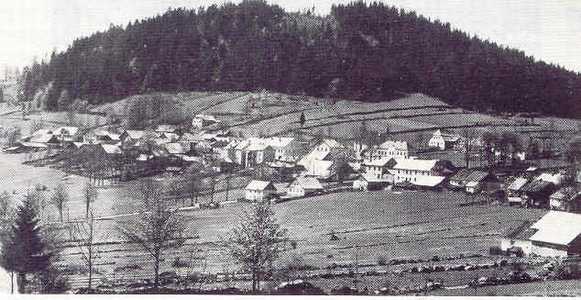
Böhmisch-Röhren lies close to the Bavarian border, and after the resettlement of the wholly German population it was therefore only very sparsely inhabited. The church in particular, the rectory, the large inns and the shops decayed and fell into ever greater neglect. For this reason the whole village centre with the church was levelled in 1966. Even those who know the area can hardly find the places of their youthful memories any more.
Böhmisch-Röhren had over 1,200 inhabitants.
Tusset
The nearest village on the southern slope of the Tussetberg was Tusset. It was a political municipality in its own right, to which Neuthal, Schwarzes Kreuz, Pechofen and Grasfurth also belonged. In 1939 it counted 678 inhabitants. The village lies on the Cold Moldau and on the railway line Wallern – Gojau, via Schwarzes Kreuz to Haidmühle – Passau. In 1910 it received a railway station. This was very important for Tusset, for the place had already been shaped by the timber industry for decades. Franz Bienert, one of the most far-sighted entrepreneurs of the Bohemian Forest, founded in Tusset the second factory for the processing of resonance wood, after Mader’s, for working this valuable timber. This took place under the most difficult economic conditions in the year 1854. He entrusted the management of the Tusset factory to his son-in-law, Johann Wessely, a trained forester. The latter proved a capable businessman and soon employed over 100 workers. In addition there were a great number of carters, for the valuable timber went all over the world. The Bienert/Wessely house was moreover known throughout the region as very hospitable, and so the foundation was also laid for the numerous tourist visits of later times. The inn „Forelle“ (Trout) was known far and wide for its excellent hospitality. When Bienert and later his son-in-law died, Prince Schwarzenberg bought the business in 1871. Timber processing at Tusset continued to be a model for all similar businesses of the Bohemian Forest.
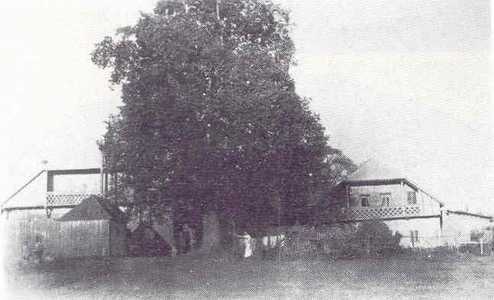
After the break-up of the great economic area of the Austro-Hungarian monarchy the business at Tusset stagnated, but once it was understood how to produce parquet timber very economically by a special process, this new branch of industry soon took a great upswing in the Tusset factory. Parquet layers from Tusset were even to be met with in castles and villas throughout the republic during the time of the great economic crisis. Their craftsmanship was famous. The economic prosperity was to be noticed at Tusset in the friendly, clean little houses and in the sociable life all the year round.
In the village there was a post office and a two-class school. Around 1785 the then owner of house no. 5, Urban Lukas, built the small village chapel. Years later he also donated a copy of a Tusset Madonna, which found its place in the small altar niche. In the chapel the parish priests of Böhmisch-Röhren held devotions and catechism classes for the people of Tusset. In 1925 the Schreiber family (Glöcklbauer/Korlbauer) had a bell frame with a timber porch erected in front of the chapel for an Angelus bell. This little bell was rung from the living room of the property at house no. 5.
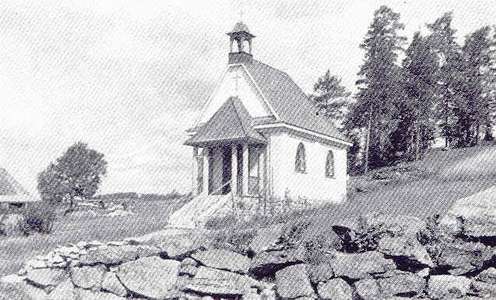
In the new Tusset Chapel at Philippsreut, too, a little bell will once again call people to prayer to Our Lady of Grace. A generous donation has made it possible.
Guthausen
On the northern slope of the Tussetberg lay the youngest municipality of the district, the woodcutters’ village of Guthausen.
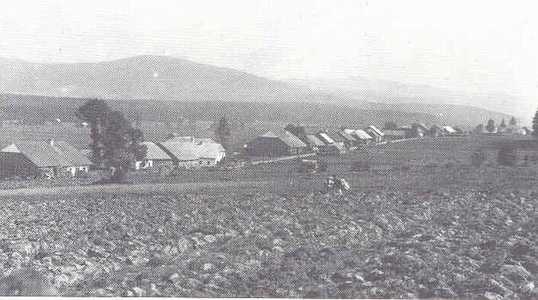
It was founded as a woodcutters’ village in the years 1816 to 1819 by a proclamation of Prince Schwarzenberg. He had been awarded the Tussetberg after a long dispute with the people of Wallern by a settlement in the year 1804. In order to be able to fend off the incursions of the Wallern herdsmen and woodcutters in future, he had the new village laid out in a wide arc, house site by house site, in the Gramet-Au on the right bank of the Moldau. The new settlers came from the surrounding villages and from Bavaria. In laborious work they cleared the patch of earth allotted to them and built the first 35 houses in a row beside the village street. This earned them the mockery of the surrounding villages. People said: „In Guthausen the geese are roasted on one side only.“ Whether the people of Guthausen – they were predominantly woodcutters and smallholders – ate geese at all for their Sunday roast is unlikely.. Nevertheless they were surely a lively, quick-witted folk, for people also said: „You go to Guthausen to get a brain!“ The local band and the large choral society enjoyed a good reputation in the neighbourhood. In 1882 a two-class school was built. Despite the hard living conditions the place grew rapidly; ten children in one family were not unusual. In 1946 there stood 78 houses with 580 inhabitants. Today Guthausen is three-quarters destroyed and almost deserted.