Emil Weber was the principal initiator; without him a cultural monument such as the new Tusset Chapel would certainly not have come into being – who knows whether the old chapel would ever have been restored.

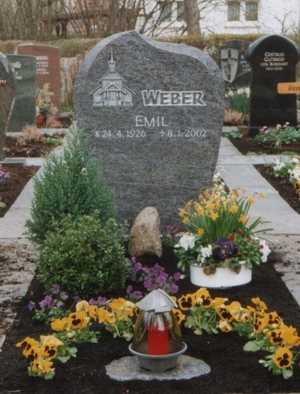
On Tuesday, 8 January 2002, Emil Weber died unexpectedly after a long and serious illness.
Emil Weber was born on 24.04.1926 in Filz (municipality of Obermoldau) in the Bohemian Forest. His parents were Anna (née Stegbauer) and Liebreich Weber. His brother Franz (*12.10.1920), who had been paralysed since the age of twelve, lived to be only 22. His sister Marie Lang (*03.04.1923) is still living, as he was latterly, in Uhingen.


His great-grandparents lived at Birkenhaid no. 9 and had many children (the exact number is not known). His great-grandfather Anton Weber was a farmer and maker of wooden goods. Both his son Josef (Liebreichen Sepperl) and the latter’s sons Johann and Liebreich (Emil’s father) carried on the tradition of woodworking. Grandfather Josef mainly made sieve rims, violin boards, clogs of spruce and grain shovels of beech, and also practised Hölzelstoßen (a form of wood shaping). As a sideline, before the First World War they drove geese from Bohemia to Bavaria and sold them there. Emil’s father told how this was done: the geese were driven, by two sheepdogs, across the border at Landstraßen – Philippsreut. On the way to Röhrenbach it could happen now and then that a Bavarian goose too was driven along by the sheepdogs. Among the Bavarians it was therefore each time „alert level 1“ when the „Sauböhm“ (a rude Bavarian nickname for Bohemians) were on the move, and every farmer took care to bring his geese to safety in good time.
In the year 1925 Emil’s parents bought house no. 2 in Filz, where his father set up on his own as a maker of sieve rims. In the 1930s, the time of the economic crisis, Emil’s father had to earn his living in the forest working for the Prince of Schwarzenberg. In 1934 his parents sold the house in Filz and moved to St Johann (Lower Austria) to an uncle of Emil’s, Kantus Stegbauer, who had been farming there since 1927.
Emil’s father made sieve rims there too. But after only a year longing drew them all back to the beautiful Bohemian Forest. From 1935 to 1936 the family lived at Elendbachl no. 8 in the Paulik house (Ondre) and for the ten following years at Elendbachl no. 7 in the Rothbauer house. Until the expulsion in June 1946 Emil’s father worked again as a maker of sieve rims at the Adolf Haselberger inn.

At Obermoldau Emil Weber attended primary school until 1940. Afterwards he learned the joiner’s trade until 1943 at the timber trade school in Wallern. From 1943 to 1945 he was a soldier in the navy. He then spent six months as a British prisoner of war before returning to the Bohemian Forest in October 1945. In 1946 came the resettlement. By way of Winterberg and Furth im Wald the road led to Grund (Griesbach district).


There, on 5 January 1948, Emil married his childhood friend Maria Prinz. Two sons came of his marriage to her: Helmut (born 2.11.1948) and Emil (born 21.5.1956)
Since in that region workers were needed only in agriculture, in 1953 Emil moved to Uhingen, to Swabia. Only a year later he began building his own home there.
The first blow of fate struck Emil Weber in 1959, when his first wife died after a serious illness and left him with their two sons Helmut and Emil.

As early as 1960 he found in Anna Spitzl of Ratschlag (municipality of Untermoldau) the woman with whom he was to spend the rest of his life. From this marriage came the sons Gerhard (born 20.6.1961) and Franz (born 1.7.1966).
Emil Weber was always deeply attached to his homeland. In the Göppingen local group of the German Bohemian Forest Association he was actively engaged in various offices for many years.
In 1978 he took over the community representation of the Bohemian Forest home community of Obermoldau. Out of his attachment to the old homeland arose his most fervent wish: the erection of a memorial. He found the right place for it in Philippsreut, a small municipality in the Bavarian Forest through which the paths of his countrymen had already led before the expulsion. In the summer of 1981 he therefore made contact with the municipality of Philippsreut for the first time and put to the mayor the proposal of a twinning between Obermoldau and Philippsreut, together with the erection of a memorial. Many discussions and meetings took place. Several models were drawn up and rejected again, until it was finally decided to reconstruct in Philippsreut the Tusset Chapel from the Bohemian Forest, which had been given over to decay. In April 1983, together with the architect Gerhard Edlmann, he visited the almost ruined chapel on the Tussetberg. Many photographs were taken there and the chapel – or rather what was left of it – was measured from the ground up. What followed were months and years of planning and finally the completion of the new chapel. Whether on holiday or after work, Emil Weber spent every free minute in a small joinery in Uhingen, building his Tusset Chapel.
After two years of building, the individual parts were loaded and transported to Philippsreut, where they were finally assembled and raised at their destination. 27 July 1987 was then one of the most significant days of his life, for on that day the new Tusset Chapel in Philippsreut was consecrated by Bishop Dr Franz Eder of Passau.
In 1987, at the third pilgrimage, the consecration of the Way of the Cross followed.
A great break came into Emil Weber’s life on 20 February 1994. A stroke paralysed his entire right side, and the ever work-hungry joiner was suddenly condemned to inactivity. Despite a further setback to his health in the summer of 1999, Emil pulled himself together again – not least thanks to the devoted care of his wife Anna – and was mostly in good spirits and content until the end. The high point of every year for him was always the pilgrimage at Philippsreut on 15 August.
During a temporary stay at the Samariter Stift in Geislingen an der Steige he lay down after his meal for his customary afternoon nap. Sadly he did not wake from that nap again.
This news struck us all like a bolt of lightning.
We shall miss him greatly.
We shall never forget him and what he did for us!
His family